
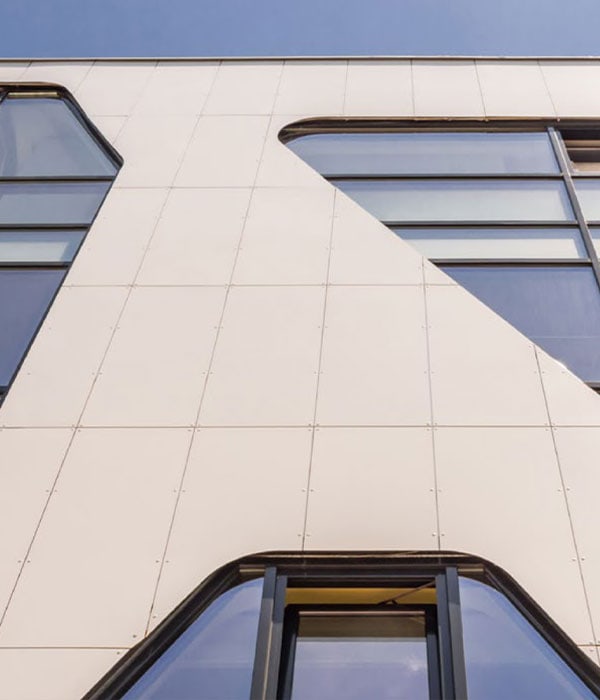
The choice of facade material significantly impacts a building's appearance, durability, and maintenance costs. High-quality facade laminate offers a modern alternative to traditional materials, combining aesthetics, durability, and practicality. Laminate facades have gained popularity, especially in public buildings and commercial spaces, where both visual appeal and long-term functionality are required.
A correctly chosen and installed facade laminate can last for decades while maintaining its original appearance. The material's versatility allows for bold design solutions and unique architectural implementations that make the building stand out from its surroundings.
What makes laminate a suitable facade material?
Laminate is suitable as a facade material due to its excellent technical properties. High-pressure laminate withstands UV radiation, temperature fluctuations, moisture, and mechanical stress without color fading or surface wear.
The structure of facade laminate consists of several layers, the uppermost of which is a transparent protective layer. This layer protects the decorative surface beneath from external factors. The phenolic resin laminate at the core of the material provides the structure with strength and dimensional stability.
Laminate's lightness compared to stone materials reduces building load and allows for easy installation. The material also does not require special tools or techniques, which speeds up the construction process and lowers costs.
What are the advantages of high-quality facade laminate compared to traditional materials?
High-quality facade laminate offers significant advantages compared to brick, concrete, or wood. It does not require regular painting, varnishing, or other surface treatments, which significantly reduces long-term maintenance costs.
From a design perspective, laminate allows for almost limitless surface options. The material can mimic natural materials like wood or stone, or offer entirely unique patterns and colors. The surface texture can be varied from smooth to deeply textured, which increases the degree of design freedom.
Ease of installation is another significant advantage. Laminate panels are lightweight and easy to handle, which speeds up work and reduces labor costs. The material's stable dimensions and uniformity reduce waste and simplify planning.
From an environmental perspective, laminate is a sustainable choice. It does not contain harmful chemicals, is recyclable, and its long lifespan reduces the need for material replacement.
How to choose the right laminate quality for a facade project?
The selection of the right facade laminate depends on the building's location, intended use, and aesthetic requirements. Primarily, it must be ensured that the material is intended for outdoor use and meets building code requirements for fire resistance and structural strength.
Climatic conditions significantly influence material selection. In cold climates, laminate must withstand freeze-thaw cycles, while in sunny conditions, UV resistance is key. In marine environments, salt resistance is an important characteristic.
The intended use of the building determines the required durability class. High-traffic areas, such as schools or hospitals, require particularly durable materials, while residential buildings can use lighter grades.
Regarding aesthetic requirements, it's important to consider color fastness, surface texture, and compatibility with other building materials. Dark colors can heat up significantly in the sun, which should be taken into account in structural design. Extensive product range enable finding a suitable solution for every project.
How is facade laminate installed sustainably?
The installation of durable facade laminate begins with careful planning and the preparation of the correct substructure. The laminate panels are attached to the frame of a ventilated facade structure, which allows moisture to escape and prevents condensation from forming.
During installation, the manufacturer's instructions regarding the number and location of fastening points must be followed. Joints between panels are sealed with weatherproof materials that allow for structural movement due to thermal expansion. Mechanical fasteners shall be selected according to the material and substructure.
Considering thermal expansion is critical for the success of the installation. Sufficient expansion joints are left between the laminate panels, which prevent the build-up of tension during temperature fluctuations. Sealants are chosen so that they can withstand UV radiation and weather variations.
The quality of the installation is ensured through regular inspections and measurements. The flatness of the panels, the strength of the fastening, and the condition of the joint seals are checked before proceeding to the next phase. A correctly installed facade laminate can last for decades with minimal maintenance.
Choosing and installing high-quality facade laminate requires expertise and knowledge of the right materials. If you are planning a facade project and want expert advice on material choices, contact us. We help you find the right solutions for your project and offer technical support throughout the entire project.