
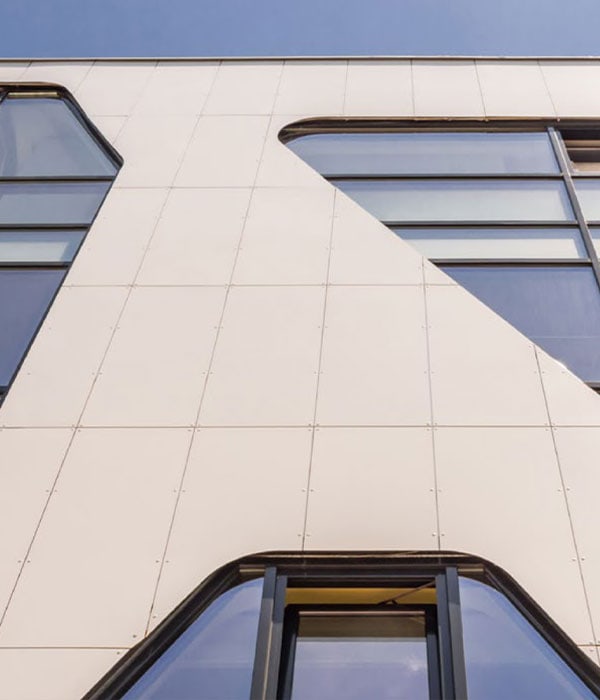
Facade laminate has become a popular choice for building exteriors due to its durability and versatility. Properly selected laminate can withstand Finland's variable weather conditions and retain its appearance for decades. This guide will help you make the right choices for your facade project.
The selection of facade materials significantly impacts a building's lifecycle costs and maintenance needs. Laminate offers a balanced solution that combines aesthetics, durability, and cost-effectiveness.
What makes laminate a suitable facade material?
Laminate is suitable as a facade material due to its excellent weather resistance, versatile design possibilities, and long service life. High-pressure laminate can withstand UV radiation, moisture, and temperature fluctuations without damage.
The layered structure of laminate makes it particularly durable for outdoor use. The melamine resin in the surface layer protects the color and pattern from fading, while the phenolic resin in the inner layers provides structural strength to the material. This combination ensures that facade laminate retains its original appearance for up to 25–30 years.
Laminate is also a fire-safe material that meets building code requirements for facade use. Its low maintenance needs make it an economical choice in the long run.
What are the most important characteristics of laminate for facade use?
The most important properties of facade laminates are UV resistance, moisture resistance, dimensional stability, and mechanical strength. These properties ensure the material's long-term performance in outdoor conditions.
UV resistance is a critical property, as sunlight causes many materials to fade and become brittle. High-quality facade laminate is treated with UV stabilizers that protect the color and structure from sunlight.
Moisture resistance prevents the material from swelling and shrinking, which could cause cracking or detachment from fastenings. Dimensional stability means that the laminate retains its shape during temperature fluctuations.
Mechanical strength is important for withstanding wind loads and potential impacts. The facade laminate is designed to withstand normal loads on the building without damage.
How do you choose the right laminate thickness for a facade?
The thickness of the facade laminate is selected based on the building's height, wind loads, and mounting method. The most commonly used thicknesses are 6–12 mm, but for high-rise buildings, panels with thicknesses of up to 15–20 mm may be required.
In low-rise buildings (1–3 stories), a thickness of 6–8 mm is usually sufficient with a sufficiently dense fastening pattern. For mid-rise buildings (4–8 stories), a thickness of 10–12 mm is recommended to achieve better rigidity.
Fastener spacing significantly impacts thickness selection. Denser fastening allows for the use of thinner panels, while sparser fastening requires thicker panels to avoid deflection.
Wind loads increase with building height, so thicker material is often needed on the upper floors. A structural engineer calculates the exact loads and determines the required thickness based on the building's conditions.
How to safely install laminate on a facade
The laminate is installed on the facade with mechanical fasteners that are attached to the building's load-bearing structure. When installing, it is important to consider thermal expansion and ensure sufficient expansion joints.
Installation begins from the bottom up, leaving a 3–6 mm expansion joint between the panels for thermal expansion. Fastening screws are placed at least 50 mm from the edges of the panel to prevent cracking.
Fasteners must be made of stainless steel or other corrosion-resistant material. The fastening points shall be sealed with a weather-resistant sealant that does not become too rigid.
During installation, ensure that the laminate sheets are dry and clean. Damp sheets can warp after installation, causing problems with appearance and sealing.
What is the difference between products from different laminate manufacturers for facade use?
Laminate manufacturers products differ in resin composition, surface treatment, and quality standards. Premium manufacturers use more advanced resin formulations and stricter quality criteria.
The resin composition directly affects the material's durability and lifespan. The highest quality facade laminates use resins specially developed for outdoor use, which better withstand UV radiation and temperature fluctuations.
Surface treatment varies by manufacturer and affects the material's appearance and cleanability. Some manufacturers offer special anti-graffiti or self-cleaning surfaces for facade use.
Quality standards and warranty terms indicate the manufacturer's confidence in their product. Leading manufacturers offer a 10–15 year warranty for color fastness and structural durability for facade applications.
Choosing the right facade laminate requires careful planning and material knowledge. Would you like to discuss your project's requirements and receive expert advice on material selection? Contact us We help you find the right solutions for your project and offer technical support throughout the entire project.