
Choosing laminate suitable for public spaces requires careful evaluation of technical requirements, wear resistance, and fire classification. Standard laminate is not enough when the space is in constant use and safety regulations are strict. In this article, we go through all the key questions that the designer must resolve before selecting the material.
What does the wear class mean in commercial laminate?
The wear class indicates how much mechanical stress the laminate can withstand before its surface begins to wear. Classes 33 and 34 are commonly used in public spaces, designed for heavy and very heavy commercial use areas. The higher the class, the more durable the surface.
The wear classification is based on standardized tests that measure surface wear resistance, impact resistance, and scratch resistance. Classes 21 and 22, intended for residential use, are not suitable for public spaces because they cannot withstand continuous traffic, wheelchairs, strollers, or heavy objects. For laminate suitable for public spaces, the wear class is always clearly marked in the technical product data, and it is the first criterion a designer must check.
Which technical features are decisive in the selection of public space lighting?
In public spaces, the decisive technical properties are wear resistance, moisture resistance, impact resistance, and surface hygiene. High-pressure laminate, or HPL laminate, is clearly superior in these properties compared to standard low-pressure laminate because its density and surface layer hardness are significantly higher.
When evaluating technical features, it is worth paying attention to the following factors:
- Surface finish: The hard surface resists scratches, impacts, and wear and tear in daily use.
- Moisture resistance: Especially in sanitary facilities and kitchens, the panel must withstand moisture and cleaning agents.
- Dimensional tolerance: The laminate for underfloor heating must remain dimensionally stable even with temperature fluctuations.
- Hygiene The smooth, non-porous surface does not collect bacteria and is easy to clean.
- Impact resistance: Important in spaces with high foot traffic or heavy equipment.
Compact laminate is an especially good choice for locations with high moisture stress, such as bathrooms, laboratories, or hospitals. Its structure is a solid panel without a separate underlayment, making it exceptionally durable.
How does the fire classification affect the choice of laminate?
The fire classification determines in which public spaces laminate can be used according to law and building regulations. Public spaces generally require at least a fire class of B-s1, d0, which means that the material must not contribute significantly to the spread of fire nor produce abundant smoke. Non-combustible laminate meets even the strictest requirements.
In Finland, building regulations and fire safety classifications are based on the European standard EN 13501-1. Fire classifications are divided into classes A1, A2, B, C, D, and E, of which A1 is non-combustible and E ignites easily. In public buildings such as schools, hospitals, hotels, and shopping centers, classes A2 or B are often required for wall and ceiling surfaces.
The designer must always check the intended use of the site and the fire class requirements specified in the building permit before selecting materials. The fire class must be clearly stated in the product's technical data sheet, and the certificate must be available for documentation.
How are the aesthetics and durability of a laminate surface balanced?
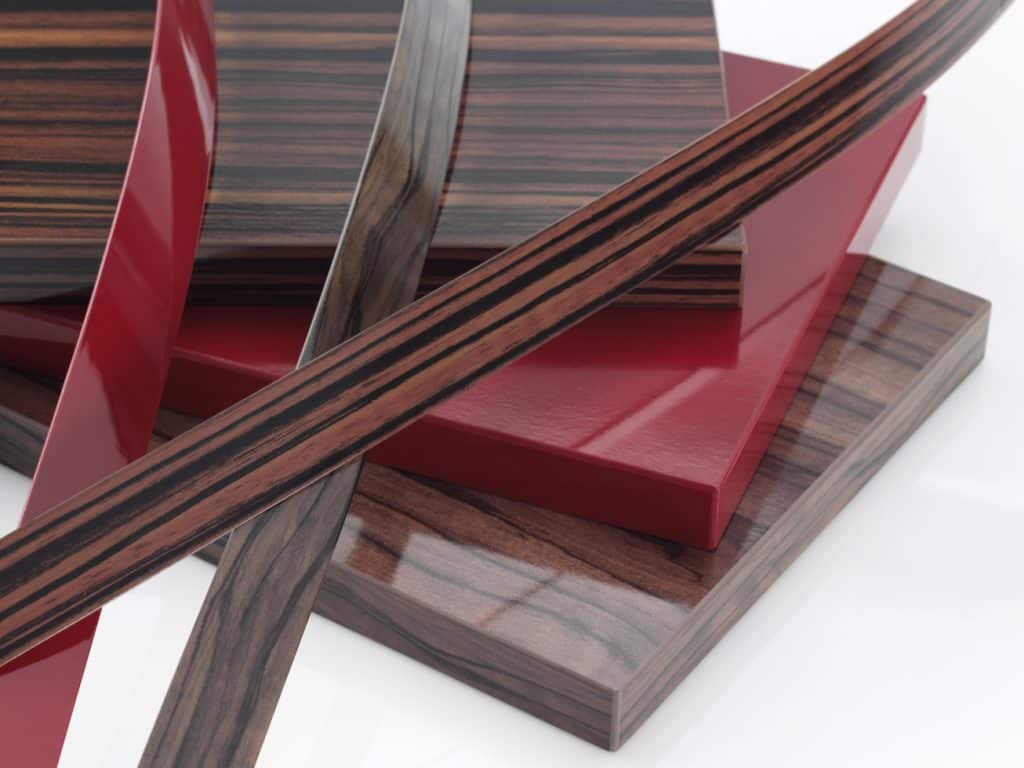
The aesthetics and durability of a laminate surface do not conflict; rather, high-quality high-pressure laminate offers both simultaneously. The choice of surface structure, color, and pattern can influence both the atmosphere of the space and how wear and tear appear in use.
Dark and heavily patterned surfaces hide scratches and signs of wear more effectively than flat, light-colored surfaces. Matte laminates are often more practical in public spaces because they do not show fingerprints as easily as glossy surfaces. At the same time, they can create a sophisticated and modern look.
ABET LAMINATI high-pressure laminates are a good example of how a wide range of colors and surface structures can be combined with technically high-level performance. The selection includes hundreds of colors, surface structures, and finishes, all of which meet the technical requirements of public spaces. This ensures that the designer does not have to compromise on aesthetics for the sake of durability.
When is laminate a better choice than other surface materials?
Laminate is a better choice than many other surface materials when a combination of cost-efficiency, a wide range of designs, easy maintenance, and technical durability is needed. Especially high-pressure laminate sheets suitable for public spaces and laminate panels are ideally suited for wall surfaces, furniture surfacing, and partition wall solutions.
Laminate is particularly competitive in the following situations:
- Large surfaces: Laminate is a cost-effective way to cover large wall or surface areas.
- Hygienic facilities: The smooth, seamless surface is easy to keep clean.
- Design Projects: The wide range of colors and surface finishes enables customized solutions.
- Fast installation schedules: Laminate sheets are easy to install and customize.
- Moisture-prone areas: Compact laminate withstands moisture better than, for example, wood or MDF.
Compared to natural stone or metal, laminate is lighter, easier to work with, and significantly more affordable. Compared to wood, it is more resistant to moisture and mechanical wear without requiring special surface treatment. HPL laminates are particularly good choices for applications where a wood- or stone-like surface is desired without the maintenance requirements of those materials.
Where to find commercial-grade laminates and their technical specifications?
Type-approved laminates and their technical specifications can be found most reliably directly from manufacturers or importers, who provide technical datasheets, fire classification certificates, and wear class documents. These documents are essential in the building permit process and for verifying the requirements of the project.
I At Lorella we offer designers and construction professionals comprehensive selection of high-pressure laminates suitable for public spaces, including ABET LAMINATI high-pressure laminates, which feature a wide range of certified products for various public environments. Product technical specifications, fire classifications, and wear resistance classes are available directly from us, and we help you find the exact right solution according to your project's requirements.
When choosing materials, you should pay attention to the following documents:
- Technical data sheet specifying the wear class, thickness, and surface properties
- Fire classification certificate according to standard EN 13501-1
- Installation instructions and recommended fastening solutions
- Maintenance and cleaning instructions that ensure the longevity of the surface
A good importer or material supplier does not only deliver the product, but also helps in clarifying technical requirements and selecting the right product on a project-by-project basis. This is especially important in public spaces, where an incorrect material choice can lead to costly repairs or safety risks. Contact our experts to support project-specific material selection.
