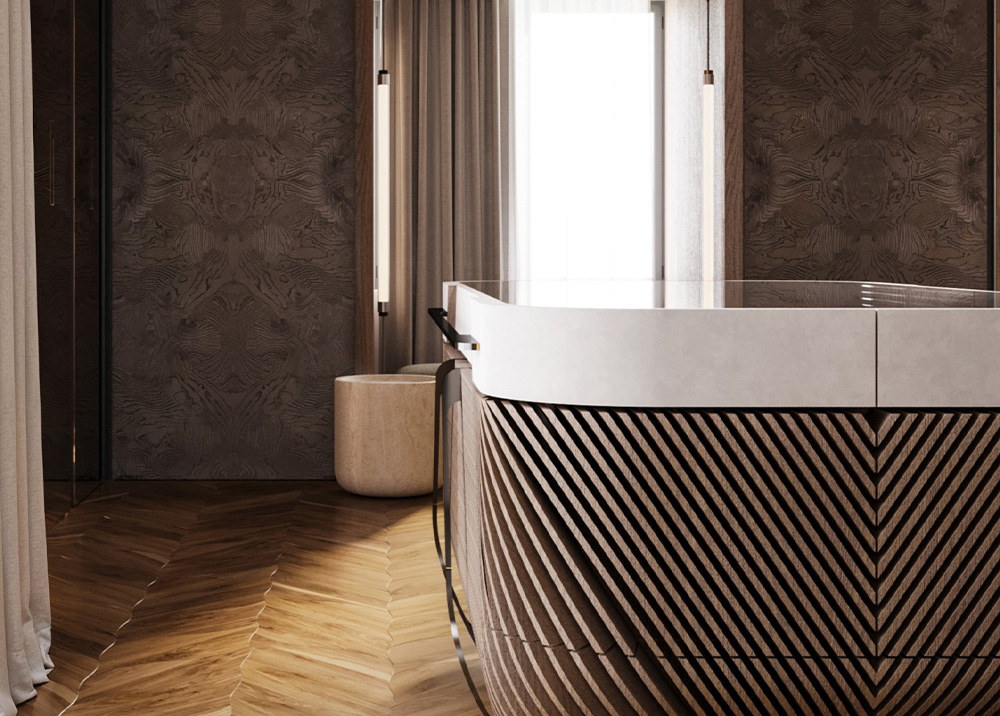
Through-dyed natural veneers are an innovative interior design solution where the wood veneer is stained evenly throughout its thickness. Unlike traditional veneers, the colour extends throughout the material, ensuring a smooth and durable finish. This feature makes through-dyed natural veneers an ideal choice for high-end interior projects that value aesthetics, durability and the natural feel of wood. Through-dyed veneers offer a wide range of colours while maintaining the natural texture of the wood.
What are dyed-through natural veneers?
The dyed-through natural veneers are real wood veneers that have been specially dyed throughout the material. Unlike traditional surface-dyed veneers, the colour pigment is absorbed evenly throughout the thickness of the veneer, making the dyeing process more uniform. much more durable and more consistent quality.
The manufacturing process uses a special pressure impregnation technique, where the natural veneer is impregnated with colour pigments under controlled conditions. This allows the colour to be fully absorbed into the wood fibre, while maintaining the original texture and natural, beautiful grain pattern of the wood.
Compared to traditional veneers, dyed-through veneers offer a superior advantage: they do not lose their colour through grinding, dents or scratches. This makes them an ideal choice for heavy-duty applications. You can discover the natural veneers dyed through by TABU, which represent the highest quality in the industry and offer unique opportunities for interior design.
Why are solid-coloured natural veneers popular in interior design?
Solid-coloured natural veneers have become popular with interior designers for a number of compelling reasons. Their unique colour depth combined with the natural beauty of real wood creates impressive finishes that are impossible to achieve with traditional surface-dyed veneers or other materials.
Sustainability is another major advantage. Because the colour extends throughout the material, minor surface scratches and wear will not reveal a different coloured base material. This greatly extends the life of the product and maintains the aesthetic appearance for longer.
Designers also appreciate the versatility of the material. Through-dyed veneers can be used in countless applications, from small details to large wall surfaces. In addition, the wide range of colours allows for individual interior design solutions, from classic to modern.
The uniformity of colour in a single production batch makes solid dyed veneers an ideal choice for large-scale projects where a uniform look is important. This feature facilitates the work of designers and ensures a predictable end result.
What are the most common uses of dyed-through natural veneers?
Through-dyed natural veneers are used in a wide range of interior design applications thanks to their durability and aesthetic qualities. Wall panels are one of the most popular applications, as veneers create impressive and warm surfaces in both homes and public spaces.
In furniture manufacturing, through-dyed veneers provide a distinctive look to furniture. They are particularly used for the surfaces of tables, cabinets, shelves and other quality furniture. The advantage of through-dyed veneers is their durability in everyday use compared to normal veneers.
Doors and door surfaces are another important application. Through-dyed veneers provide a durable and attractive surface for both interior doors and furniture doors. The material's wear resistance is particularly valued in public spaces such as hotels and offices.
In the kitchen design, solid-coloured natural veneers are used for cabinet doors, worktop edgings and decorative elements. They bring warmth and naturalness to the kitchen combined with a contemporary look.
In public spaces such as hotels, restaurants and corporate offices, through-dyed veneers are used to create impressive and durable surfaces. The material's good wear resistance makes it an ideal choice for spaces with high footfall. Check out the completed veneer interior design projects and find inspiration for your own project.
How to install and maintain natural veneers?
The installation of through-dyed natural veneers requires professional skills and the right tools to achieve the best results. Veneers glued at usually on various frame materials such as MDF, chipboard or plywood. Special carpentry adhesives are used to ensure a durable fixing.
After installation, the surface is usually finished with varnish, oil or wax to protect the veneer from dirt and moisture. The finish also enhances the natural texture of the wood and deepens the colour. The type of finish chosen will have a significant impact on the final appearance and durability of the surface.
Maintenance is simple, which is one of the advantages of dyed-through veneers. Cleaning is as simple as wiping with a damp cloth, and the surface can be protected by regular waxing or oiling, depending on the finish used. Unlike normal veneers, through-dyed veneers do not reveal the lighter underside when scratched.
It is also easier to repair damaged surfaces than with traditional veneers. Small scratches can be sanded away without changing the colour, and more extensive damage can be repaired locally without having to refinish the whole surface.
What are the sustainability aspects of dyed natural veneers?
Natural dyed-through veneers are in many ways an environmentally friendly choice as a decorative material. Because veneers are thin slices of wood, a single frame yields significantly more surface material than solid wood. This makes more efficient use of valuable wood raw materials.
Many manufacturers use responsibly managed forests as a source of raw materials and comply with FSC or PEFC certification requirements. This ensures that trees are harvested in a sustainable way that respects forest biodiversity.
The dyeing process has evolved over the years to become more environmentally friendly. Increasingly, water-based inks and sustainable production methods are being used to reduce the environmental impact. Compared to many synthetic materials, dyed veneers offer a natural alternative with a lower carbon footprint.
Long life is also an important aspect of sustainability. Since dyed-through veneers are more resistant to wear and tear than regular veneers, they do not need to be replaced as often. This reduces material consumption and waste in the long run.
What should be considered when choosing natural veneers with a dyed-through finish?
When choosing natural veneers that have been dyed through, it is important to consider several factors to ensure a successful result. Application requirements are a primary consideration - different veneer types and colours to suit different spaces and uses.
The choice of colour is an essential part of the design process. It is worth bearing in mind that there is always some variation in natural materials, even though dyed veneers are more uniform than traditional veneers. Always ask for sample pieces and examine them in the lighting in which the final product will be displayed.
The choice of wood species has a significant impact on the final result. Different species of wood take up colour in different ways, and their natural grain pattern affects the visual appearance. Check out our wide range of dyed-through natural veneers to find the most suitable options for your project needs.
The reliability of the supplier and the quality of the products are decisive factors. Choose a supplier that offers comprehensive product information, technical specifications and installation instructions. High-quality veneers are an investment that pays for itself in long-term durability and timeless appearance.
The choice of finishing method affects both the appearance and durability of the veneer. Talk to the experts about the best finishing option for your project, taking into account the occupancy of the space and cleaning needs.
We can provide you with expert help in the selection and use of dyed-through natural veneers. We offer a wide range of high quality veneer products to suit even the most demanding interior design projects.