Composite panels have become one of the most popular surface materials in design projects due to their versatility and durability. These technical materials offer designers limitless possibilities to create unique and functional solutions for various interior and construction projects.
Composite materials combine aesthetics and practicality in a way that makes them an excellent choice for both public spaces and private details. Let's take a closer look at why composite panels are so well-suited for design projects and how they can be utilized in various applications.
What are composite panels and why are they suitable for design projects?
Composite slabs are an artificial stone material made by combining natural minerals, resin, and pigments. This combination produces a uniform, non-porous surface that offers both durability and design flexibility.
In design projects, composite panels excel due to their customizability. The material can be shaped, bent, and joined seamlessly, allowing for the creation of organic forms and complex geometries. Kerrock composite panels in design projects are particularly popular because they offer a wide range of colors and allow for customized solutions.
A composite board is also a hygienic choice, as its dense surface does not absorb dirt or bacteria. This makes it an ideal material for kitchens, bathrooms, and other spaces where cleanliness is important.
What are the main advantages of composite panels in design projects?
The biggest advantage of composite panels in design projects is their unlimited customizability and the possibility of seamless joints. The material can be shaped into three-dimensional structures without visible seams.
Thanks to colored composite panels, designers can implement bold color schemes and create cohesive finishes. The material is through-colored, so minor scratches or wear are not prominently visible. Composite materials also resist UV radiation, ensuring colors remain vibrant for years.
Thanks to their wet room properties, composite panels are ideal for bathrooms and saunas. They do not absorb moisture and do not mold or crack due to humidity fluctuations. This makes them a reliable choice for demanding conditions.
Technical advantages in design use
Composite panels also offer significant technical advantages. Their heat resistance allows hot dishes to be placed directly on the surface, although the use of heat protectors is recommended. The material is also impact-resistant and withstands daily wear and tear well.
How can composite panels be modified and processed for design needs?
Composite boards can be sawn, milled, drilled, and sanded with standard woodworking machines. The material's machinability allows for easy implementation of complex shapes and details.
Heating allows a composite sheet to be bent into curved surfaces, opening up new design possibilities. Thermoforming makes it possible to create rounded edges and organic shapes, for example. KERROCK composite sheets are particularly suitable for this application due to their consistency.
Bonding is done with a special adhesive that forms an invisible seam once dry. This allows for the construction of large surfaces from smaller panels without the joints being visible in the final result. Edge finishing can be done with a milling tool, providing a professional finish.
What applications are composite panels best suited for in interior design?
Composite sheets are best suited for kitchen countertops, bathroom furniture, wall surfaces, and custom interior design elements. Their versatility makes them an ideal choice for demanding design projects.
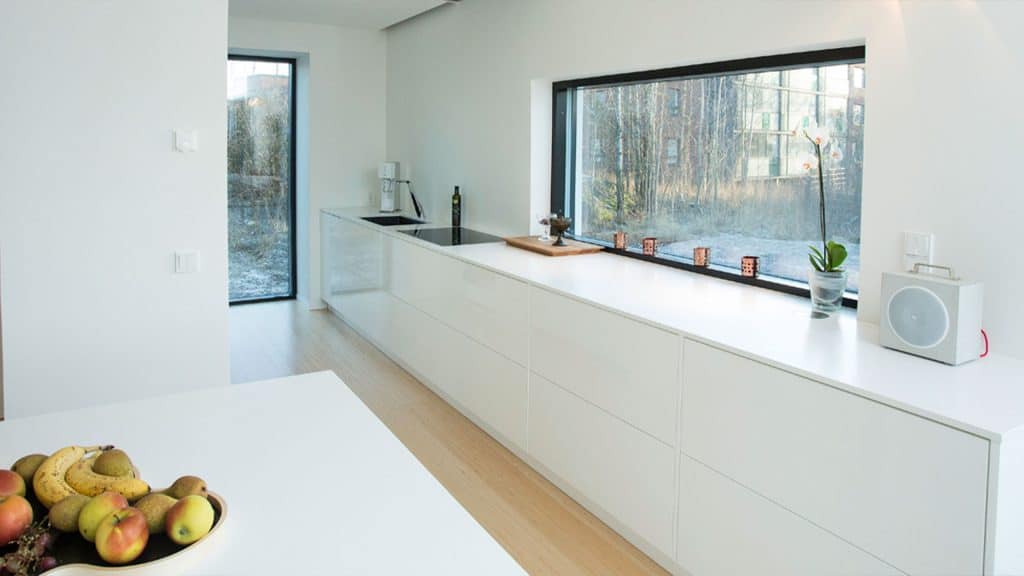
In kitchens, composite materials excel as countertops due to their hygiene and ease of maintenance. Seamless joints prevent the accumulation of dirt and moisture, making cleaning effortless. Integrated sinks and drainboards can be made from the same material to achieve a cohesive look.
In bathrooms, the wet-room board features make composite boards an excellent choice. They are suitable for vanity cabinets, shower walls, and the areas around floor drains. The material can withstand continuous moisture and temperature fluctuations without becoming brittle.
Specialty applications in design objects
In public spaces, composite panels work excellently for reception areas, store fixtures, and decorative elements. Their durability and ease of maintenance make them a practical choice for high-traffic areas.
How do composite panels hold up to use and wear in design applications?
Composite panels excellently withstand daily wear and tear and retain their appearance for decades with proper care. Their dense structure makes them scratch-resistant and stain-proof.
Kerrock composite panels are designed to withstand intensive use. They will not crack, fade, or lose their shape over time. The material is also chemical-resistant, making it suitable for environments where cleaning agents are used regularly.
Minor scratches and signs of wear can be sanded away and the surface can be re-polished to its original appearance. This renewability makes composite panels a durable investment for long-term use. When properly maintained, the composite surface will retain its original appearance and functionality for decades.
Would you like to know more about how composite panels can fit your specific design project? We can help you find the best material solutions for your project and provide expert support throughout the entire process. Contact us, Then let's discuss together the possibilities of implementing your vision into practical solutions.