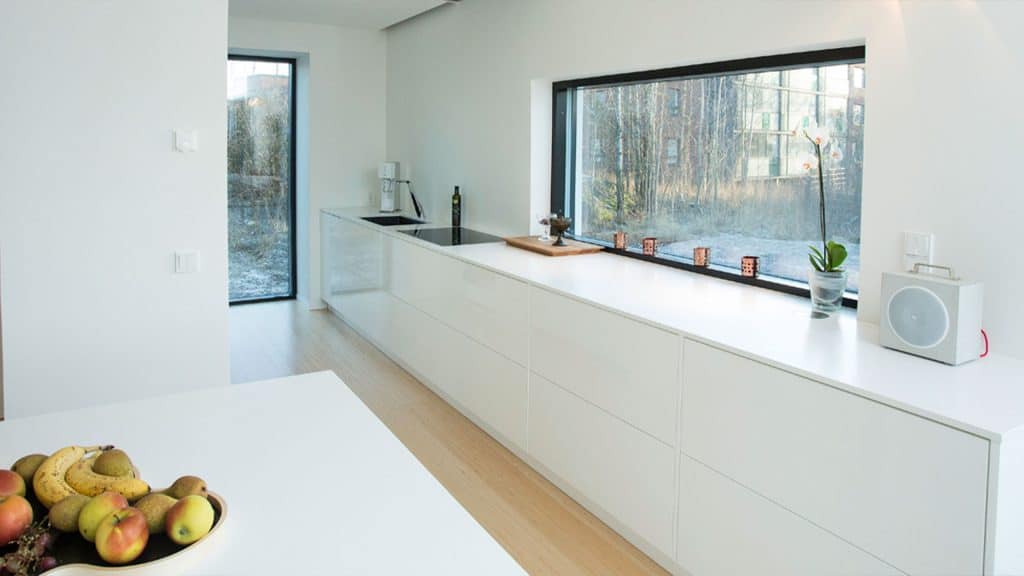
Composite panels have secured their place in modern construction and interior design thanks to their exceptional properties. These innovative surface materials offer durability, versatility, and aesthetics that traditional materials cannot provide. Composite materials are particularly well-suited for demanding applications where both technical performance and visual appeal are required.
Construction professionals and designers have found composite panels to be a solution to many challenges. They are exceptionally well suited for wet rooms, public spaces, and demanding applications where exceptional durability and easy maintenance are required of the material.
What are composite panels and why are they popular in construction?
Composite panels are artificial surface materials manufactured by combining mineral fillers, such as aluminum hydroxide powder, with acrylic resin. This combination creates a solid, homogeneous material that is colored throughout and workable like natural stone.
Their popularity in construction is due to unique properties. The composite panel is completely non-porous, making it hygienic and easy to maintain. The material withstands moisture, chemicals, and wear very well, which is why it is ideally suited for demanding applications. In addition, composite panels can be repaired from minor damage by sanding and polishing, which significantly extends their service life.
From a design perspective, composite materials offer unlimited possibilities. They are available in numerous colors and textures, and they can be formed into seamless surfaces even for complex shapes. This makes them a popular choice both to private spaces and public spaces.
What are the main advantages of composite panels compared to traditional materials?
The biggest advantages of composite sheets are non-porosity, reparability, hygiene, and formability. Unlike natural stone or laminates, composite sheets do not absorb liquids or bacteria, making them an ideal choice for spaces where cleanliness is important.
Compared to natural stone, composite materials are lighter and easier to install. They do not require sealing because the material is non-porous. Natural cracks and pores in natural stone can cause problems in wet areas, whereas the composite panel remains stable in all conditions.
Compared to laminates, composite panels are significantly more durable and repairable. If a laminate surface is damaged, the entire panel often needs to be replaced. A composite panel, on the other hand, can be repaired on-site by sanding and polishing, which saves both time and costs.
Compared to wood materials, composite panels do not rot, swell, or shrink due to moisture. They also have better resistance to chemicals and temperature fluctuations, making them a practical choice for kitchens and bathrooms.
How are composite panels used in bathrooms and wet rooms?
In bathrooms, composite panels are primarily used for vanity tops, shower walls, and floor surfaces. The non-porous nature of the material makes it ideal for wet room use, as it does not absorb moisture or provide a breeding ground for bacteria or mold.
Countertops are one of the most popular applications. The composite board can be shaped into a seamless unit where the sink and countertop are made of the same material. This eliminates joints where dirt or moisture could accumulate. The material can also be bent and shaped, allowing for rounded corners and other design elements.
In shower areas, composite panels provide a waterproof and easy-to-maintain solution. Unlike tiles, the composite surface has no joints that would require regular maintenance. The material also withstands detergents and disinfectants well, which makes cleaning easier.
In wet space applications, composite materials offer a long-lasting solution. They withstand continuous moisture stress without losing their strength or appearance. Installation is also relatively simple, as the material can be cut and shaped on-site.
How to choose the right composite panel for your project?
Choosing the right composite panel depends on the application, load, and aesthetic requirements. First, it is necessary to assess what kind of stress the surface will experience and which properties are most important for the project.
Depending on the application, it is advisable to choose the appropriate thickness. For basin countertops, a thickness of 12–20 mm is usually sufficient, while thicker slabs may be needed for floor applications. In public spaces subject to heavy wear, it is advisable to choose a thicker material to ensure durability.
When choosing color and texture, both aesthetics and practicality must be considered. Darker colors hide small scratches better, but lighter shades give the space a more spacious feel. Glossy surfaces look elegant, but matte surfaces are more practical because they do not show fingerprints as easily.
Regarding technical features, it is worth paying attention to heat resistance if hot objects will be placed on the surface. Chemical resistance is important in laboratories and industrial sites. Slip resistance is essential in flooring applications to ensure safety.
How to correctly install and process composite panels?
The installation of composite panels requires careful planning and the use of the right tools. The material is cut using sawing equipment equipped with a diamond blade, and the edges are finished by sanding them flat and smooth.
Installation begins with precise measurement and modeling. The composite panel can be shaped on-site, but careful planning saves material and reduces waste. The panels are attached to the substrate using structural adhesive or mechanical fasteners, depending on the application.
For joining, a special glue is used, the shade of which is as close to the color of the panel as possible. The joints are sanded and polished until invisible, resulting in a seamless whole. In the processing, it is important to use the correct sanding and polishing agents in accordance with the manufacturer's instructions.
Edge finishing is done using sandpaper from coarse to fine. Finally, the surface is polished to restore the original gloss. When done correctly, the joints are practically invisible and hold up just as well as the original material.
Occupational safety is important when working with composite panels. Grinding creates fine dust, so a respirator and dust extraction are necessary. Eye protection is also recommended in case of flying debris.
If you are planning to use composite panels in your project, we will help you find the exact right solutions for your needs. We have a wide selection of high-quality composite materials, like Kerrock composite sheets, that are suitable for various applications. Contact our experts, then we will design the best material solution for your project together.